
 繁体中文
繁体中文 简体中文
简体中文 Deutsch

What Is the Most Durable Wood for a Dining Table? Ultimate Hardwood Ranking & Buyer's Guide
Selecting the perfect centerpiece for your home or retail catalog is an investment in both aesthetic appeal and structural longevity. When sourcing high-end Dining Room Furniture, interior designers, homeowners, and B2B buyers alike prioritize one foundational attribute above all others: durability. A dining table is not merely a piece of static decor; it serves as the vibrant heart of everyday life. From family breakfast rituals and remote work sessions to bustling dinner parties and commercial hospitality events, it withstands continuous daily impact, liquid exposure, heat, and structural strain.
Understanding which timber offers maximum resilience against scratches, warping, dents, and moisture is critical. In this comprehensive guide, we unpack the science of timber density, compare premier hardwoods such as Acacia, Oak, Maple, Walnut, and Teak, and reveal how innovative engineering transforms solid wood into functional, versatile furniture masterpieces.
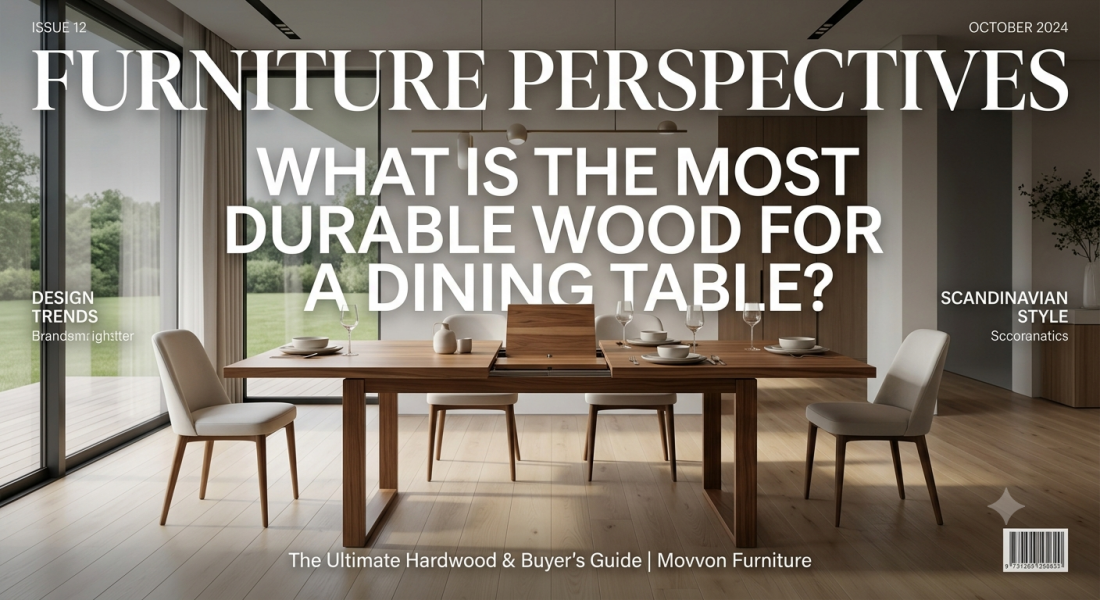
Table of Contents
- 1. Understanding Wood Durability: The Science Behind the Janka Hardness Scale
- 2. Hardwoods vs. Softwoods: Why Wood Type Matters in Dining Furniture
- 3. The Top Contenders: In-Depth Breakdown of the Most Durable Woods
- Acacia Wood: The Unbeatable Heavyweight of Value and Resilience
- Oak Wood (White & Red): The Eternal Classic of Timeless Strength
- Hard Maple: Extreme Density for Heavy-Duty Use
- American Black Walnut: Luxurious Elegance with High Stability
- Teak: Ultimate Natural Resistance to Moisture and Environmental Stress
- 4. Side-by-Side Comparison Matrix of Hardwood Species
- 5. Beyond Raw Wood: Engineering & Craftsmanship for Maximum Longevity
- 6. The Movvon Advantage: Patented Functionality & Factory-Direct Precision
- 7. Practical Maintenance Strategies to Extend Table Lifespan
- 8. Key Takeaways for Retailers, Distributors, and Interior Designers
- 9. Frequently Asked Questions (FAQs)
1. Understanding Wood Durability: The Science Behind the Janka Hardness Scale
When assessing wood durability for dining furniture, industry experts rely on a standardized scientific metric known as the Janka Hardness Scale. Developed by Gabriel Janka in 1906, this test measures the precise force required to embed a 0.444-inch (11.28 mm) steel ball halfway into a specimen of wood. The result is expressed in pounds-force (lbf) or Newtons (N).
The higher the Janka rating, the harder and more resistant the wood is to denting, puncturing, and surface wear. For dining tables—where dropped silverware, heavy cookware, and constant movement occur daily—a higher Janka rating directly correlates with longevity. However, raw Janka hardness is only one piece of the durability puzzle. Complete timber durability encompasses three vital factors:
- Janka Hardness Rating: Resistance to impact, surface pressure, and denting.
- Dimensional Stability: How well the wood resists expanding, shrinking, cracking, or warping when exposed to shifts in ambient humidity and temperature.
- Natural Resin and Oil Content: Natural organic compounds within the grain that protect against moisture penetration, fungal rot, and insect damage.
2. Hardwoods vs. Softwoods: Why Wood Type Matters in Dining Furniture
To choose the most durable wood, one must first understand the botanical distinction between hardwoods (angiosperms) and softwoods (gymnosperms). Contrary to popular belief, the distinction is not purely about physical hardness, but rather plant reproduction and cellular structure.
Softwoods (Pine, Cedar, Fir, Spruce)
Softwoods originate from coniferous, evergreen trees with needle-like leaves and exposed seeds. Their cellular structure contains open pores, making them light, easy to work, and relatively soft. While pine dining tables are popular for rustic, budget-friendly decor, softwoods are easily scratched by fingernails, dented by coffee mugs, and prone to swelling in humid environments. They generally lack the density required for heavy-duty commercial or long-term residential use.
Hardwoods (Acacia, Oak, Maple, Walnut, Teak)
Hardwoods come from broad-leafed deciduous trees that reproduce via enclosed seeds and grow at a much slower rate. This slow growth produces dense cellular structures with tight grain patterns, resulting in superior weight-bearing capacity, dent resistance, and tensile strength. For high-end, long-lasting dining tables, genuine hardwoods are non-negotiable.
3. The Top Contenders: In-Depth Breakdown of the Most Durable Woods
Acacia Wood: The Unbeatable Heavyweight of Value and Resilience
Janka Hardness: ~1,700 - 2,300 lbf (varies by species)
Acacia has rapidly emerged as a favorite among global furniture designers and high-volume distributors. Boasting an extraordinarily high Janka rating that surpasses both White Oak and Maple, Acacia is exceptionally hard, dense, and scratch-resistant.
What sets Acacia apart is its high concentration of natural oils and water-resistant resin glands. Historically utilized in shipbuilding, Acacia natural wax coating renders it highly impervious to liquid spills—making it ideal for busy dining rooms and commercial dining environments. Visually, Acacia features rich, warm golden-brown tones with contrasting light sapwood streaks and dynamic, unpredictable grain patterns. This natural variance creates striking visual character while camouflaging minor surface scuffs over decades of use.
Oak Wood (White & Red): The Eternal Classic of Timeless Strength
Janka Hardness: 1,360 lbf (White Oak) / 1,290 lbf (Red Oak)
Oak remains the global benchmark for traditional and modern furniture craftsmanship. While both Red Oak and White Oak offer outstanding structural rigidity, White Oak is superior for dining table applications.
White Oak features closed-cell structures called tyloses, which plug the wood pores and render it exceptionally resistant to water absorption, rot, and fungal decay. Its prominent, straight grain lines and subtle ray fleck patterns provide an elegant, refined aesthetic that fits seamlessly into minimalist European, Scandinavian, or industrial interior designs. White Oak takes stains and protective topcoats exceptionally well, allowing manufacturers to offer diverse color finishes from raw light natural tones to deep smoked hues.
Hard Maple: Extreme Density for Heavy-Duty Use
Janka Hardness: 1,450 lbf
Hard Maple (also known as Sugar Maple) is renowned for its immense density and fine, uniform texture. Because of its incredible resistance to abrasive wear, Hard Maple is frequently chosen for commercial bowling alleys, basketball courts, butcher blocks, and heavy-use dining facilities.
Hard Maple exhibits a light cream to subtle reddish-brown hue with a tight, subtle grain structure. Its dense surface makes it virtually immune to deep scratches and dents. However, because Hard Maple has very tight pores, it requires expert precision during staining and finishing to ensure an even finish. When sealed with high-grade polyurethane or UV-cured lacquers, a Maple dining table will endure decades of continuous family dining without showing structural fatigue.
American Black Walnut: Luxurious Elegance with High Stability
Janka Hardness: 1,010 lbf
While American Black Walnut registers slightly lower on the Janka hardness scale than Acacia or Maple, it remains one of the most coveted luxury hardwoods in the world. Its true durability lies in its legendary dimensional stability.
Black Walnut exhibits minimal shrinkage and expansion in response to seasonal humidity shifts, preventing top panels from warping, splitting, or checking over time. Beyond its physical performance, Black Walnut is prized for its rich chocolate-brown tones, purple undertones, and dramatic swirl grain structures. It offers a premium feel that ages gracefully, developing a warm patina over time that adds value to high-end residential interiors.
Teak: Ultimate Natural Resistance to Moisture and Environmental Stress
Janka Hardness: 1,155 lbf
Teak (Tectona grandis) represents the pinnacle of natural timber weatherproofing. Native to tropical regions, Teak is naturally infused with rubber resins and high concentrations of protective essential oils. Even after being cut, dried, and transformed into fine furniture, Teak retains these natural oils, making it almost completely impervious to water damage, rot, termites, and fungal invasion.
Although Teak is often chosen for outdoor dining environments, its distinct warm golden hue, exceptional stability, and smooth tactile surface make it a prized material for luxury indoor dining spaces. Its high price point reflects its scarcity and unmatched durability performance.
4. Side-by-Side Comparison Matrix of Hardwood Species
To help B2B buyers, distributors, and consumers weigh their options, the following comparison matrix summarizes key technical performance metrics for the leading dining table timbers:
| Wood Species | Janka Hardness | Dent & Scratch Resistance | Moisture Resistance | Dimensional Stability | Best Suited For |
|---|---|---|---|---|---|
| Acacia | 1,700 - 2,300 lbf | Exceptional | High (Natural Resins) | High | High-traffic homes, modern versatile tables, dynamic aesthetics |
| White Oak | 1,360 lbf | Very High | Very High (Closed Tyloses) | High | Scandinavian, contemporary, and commercial contract dining |
| Hard Maple | 1,450 lbf | Extremely High | Moderate | Moderate to High | Heavy usage, clean minimalist designs, butcher-block tops |
| Black Walnut | 1,010 lbf | Moderate to High | Moderate | Superior (Minimal Warping) | Luxury executive spaces, designer dining collections |
| Teak | 1,155 lbf | High | Maximum (High Oil Content) | Superior | Indoor/Outdoor luxury dining, high-humidity environments |
5. Beyond Raw Wood: Engineering & Craftsmanship for Maximum Longevity
While selecting a high-Janka hardwood provides a strong foundation, raw timber alone does not guarantee a lifetime table. Without precise manufacturing techniques, kiln drying, and structural engineering, even the hardest solid wood can warp, split, or fail at joinery points.
1. Scientific Kiln Drying
Freshly harvested timber contains high moisture levels (often over 50%). If crafted directly into furniture, the wood will lose moisture as ambient humidity shifts, leading to severe twisting and cracking. Superior manufacturers utilize computer-controlled vacuum kiln drying to reduce moisture content down to an exact 8% – 12% equilibrium moisture content (EMC). This locks the cellular matrix into a stable state before cutting.
2. Precision Edge-Gluing and Grain Alignment
To craft wide dining surfaces without risk of warping, master craftspeople assemble solid timber planks by alternating grain orientation (end-grain pattern reversal). Joined using high-tensile industrial resins under hydraulic pressure, edge-glued panels are structurally stronger and far more stable than a single wide solid slab.
3. Multi-Layer Protective Finishes
Raw hardwood must be sealed against moisture, UV rays, and food stains. Advanced finishing techniques include multi-coat polyurethane coatings, natural hardwax oils, or eco-friendly UV-cured lacquers that bind chemically to the wood fibers. This protective barrier seals the timber pores without hiding the natural grain beauty.
6. The Movvon Advantage: Patented Functionality & Factory-Direct Precision
At Movvon Furniture, we believe that extreme timber durability should be paired with intelligent design. As a premier manufacturer with over 16 years of expertise in functional table engineering, we redefine modern living spaces by creating tables that combine raw material integrity with seamless adaptability.
Driven by Innovation, Backed by Capacity: Operating from a state-of-the-art facility spanning over 100,000 square feet in Foshan, China, Movvon Furniture serves as a trusted OEM & ODM partner for leading distributors, retail chains, and e-commerce brands across Europe, North America, Australia, and Asia.
Patented Mechanisms & Multi-Functional Adaptability
The core strength of a Movvon table lies in its ability to adapt. We design and manufacture extendable, lift-top, and multi-functional dining tables equipped with our proprietary, patented extension hardware. Unlike traditional extendable tables that suffer from sticky wooden glides or unstable leaves, Movvon’s precision-engineered steel and aluminum extension mechanisms operate effortlessly, allowing one person to expand seating capacity within seconds.
Rigorous Quality Control & Automated Production
Our modern manufacturing facility features automated CNC cutting lines, precision woodworking machinery, and strict unit-by-unit quality control testing. Every solid wood top panel undergoes strict moisture checks, load testing, and mechanism smooth-operation tests before packaging. This automated efficiency allows us to deliver factory-direct pricing, fast lead times, and ready-to-sell assets that maximize profit margins for our global B2B partners.
7. Practical Maintenance Strategies to Extend Table Lifespan
Even the most durable hardwood dining table benefits from basic proactive care. To preserve the finish and structural integrity for decades, recommend these simple steps to end users:
- Control Indoor Humidity: Maintain ambient indoor humidity between 35% and 55% using humidifiers or dehumidifiers to prevent natural wood expansion and contraction.
- Use Coasters and Trivets: Although dense hardwoods resist heat, hot pots (over 80°C/176°F) placed directly on the finish can cause thermal shock and leave white ring marks on the sealant.
- Wipe Spills Promptly: Clean up liquid spills immediately with a soft, damp microfiber cloth. Avoid harsh chemical cleaners, bleach, or abrasive scouring pads.
- Avoid Direct Sunlight: Protracted exposure to direct UV rays can alter wood color over time. Position tables away from unshaded south-facing windows or use UV-filtering window treatments.
8. Key Takeaways for Retailers, Distributors, and Interior Designers
For commercial furniture buyers and brand managers seeking to expand their dining collection catalog, balancing material durability, cost efficiency, and functional features is key to driving sales:
- Choose Acacia or Oak for Mass Appeal: Acacia offers unbeatable hardness and cost efficiency for modern consumers, while White Oak provides classic, high-end appeal with exceptional water resistance.
- Prioritize Multifunctionality: Modern urban homes demand space-saving solutions. Offering durable solid wood tables featuring smooth extension mechanisms meets growing market demand for flexible living spaces.
- Partner with Reliable Manufacturers: Partnering with an experienced OEM/ODM partner like Movvon Furniture ensures consistent material sourcing, rigorous quality control, and scalable production capacity.
9. Frequently Asked Questions (FAQs)
Q1: Is Acacia wood better than Oak for a dining table?
Both woods are exceptional choices. Acacia is physically harder (higher Janka rating) and often features richer color variations at a competitive price point. White Oak offers superior dimensional stability, a straight classic grain pattern, and classic timeless appeal. Choose Acacia for dramatic natural grain and dent resistance, or Oak for minimalist, Scandinavian-style aesthetics.
Q2: Can solid wood dining tables warp over time?
Solid wood is a natural, hydro-active material that responds to moisture in the air. However, properly kiln-dried wood (8–12% moisture content) that is correctly sealed and engineered with alternating grain patterns will remain stable and flat for generations under normal indoor climate conditions.
Q3: What makes Movvon extendable dining tables more durable than standard options?
Movvon Furniture combines premium kiln-dried hardwoods with patented, heavy-duty metal extension hardware. Our mechanisms undergo cycle testing to ensure thousands of smooth, silent operations without sagging or binding. Furthermore, our 100% unit-by-unit quality control process guarantees that every table shipped meets international durability standards.
Q4: How does Movvon support B2B partners, distributors, and e-commerce sellers?
We provide full OEM and ODM customization, factory-direct efficiency, strict quality assurance, and complete sales-ready assets (high-resolution product photography, 3D renderings, and technical specification sheets) to help our partners expand their market presence quickly and profitably.
Elevate Your Furniture Portfolio with Movvon Furniture
Are you a furniture distributor, retailer, or online brand looking for high-margin, durable, and customizable dining solutions? Partner with Movvon Furniture to access cutting-edge designs, patented extendable mechanisms, and reliable factory-direct manufacturing.
Explore Our Catalog & Request a Quote Today